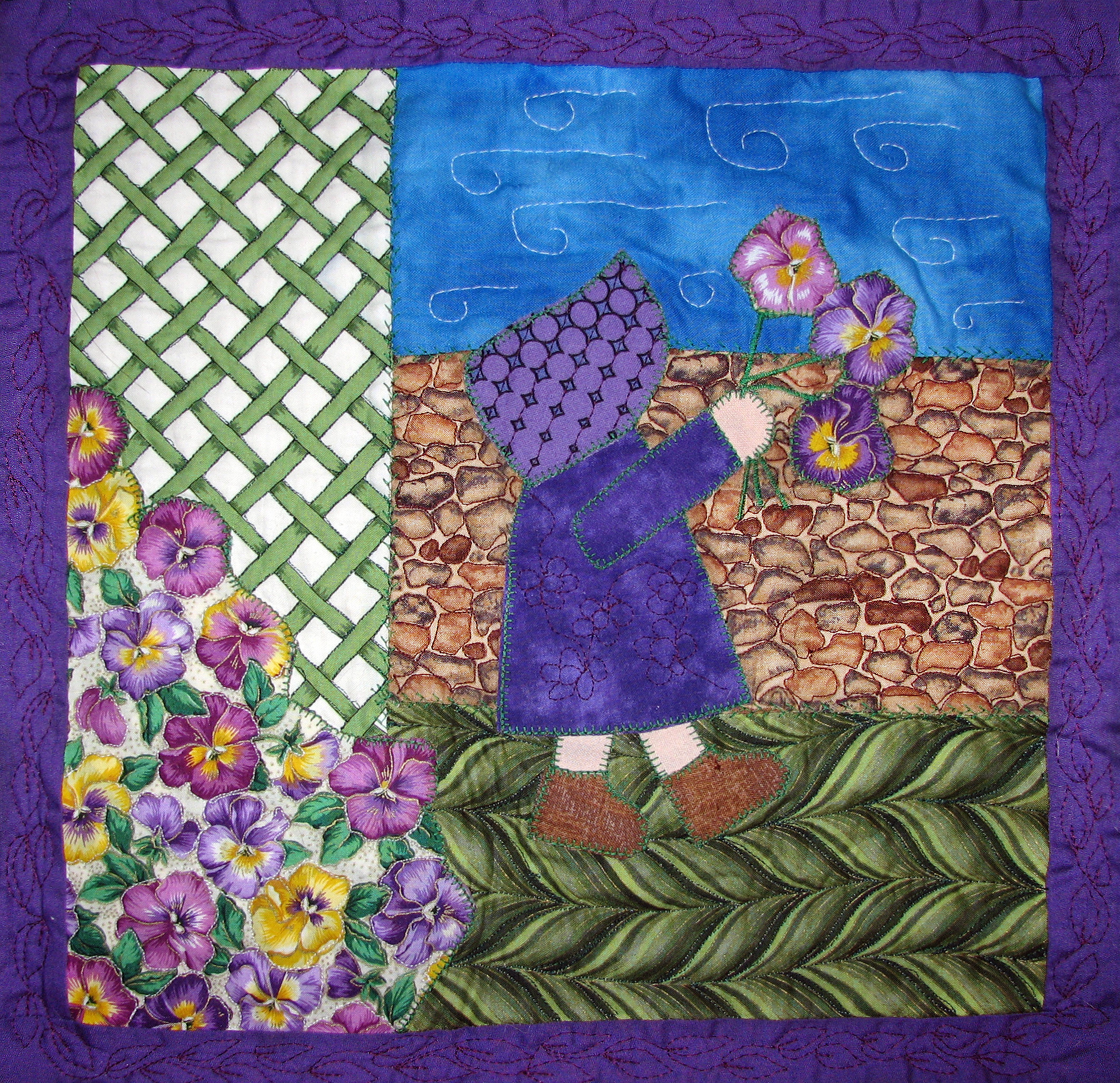
I've been "going big" (as
Elizabeth would say) with free motion quilting the last week or so, experimenting in earnest. It's time to talk about what I've learned. I'm hoping I can encourage other free motion newbies to get beyond the intimidation.
1. Have the right machine for the job. While quilters do free motion quilting on all kinds of sewing machines from standard home models to longarms, I wasn't able to be successful on my standard sewing machine. Last year, I attempted free motion quilting on my trusty little Kenmore. While it is work to shove a big quilt through a standard harp, it can be done. The issue that made it impossible for me to succeed on the Kenmore is the fact that the Kenmore just wouldn't go slow enough. If I slowed down enough where I could I manage, the Kenmore stalled.
For me that meant an upgrade to a Juki TL98Q, which is considered a mid-arm. While the Juki will do 1500 stitches per minute, it will also
crawl. Very good for a free motion quilting newbie. I realize a lot of FMQ videos show the quilters zipping through the motions at high speed. This is not appropriate for newbies. To me, that's like a new driver starting out learning to drive on the freeway. Being able to go slow while you build control and confidence is a must in my opinion. Just to be clear, I'm not dissing standard machines. If your standard machine can do the job, that's great. I'm just saying my standard machine wasn't up to the job.
2. Feathers are the most forgiving FMQ design that you can do after stippling.
You probably don't believe me. If someone had said that to me before I tried feathers, I would have thought she was nuts. Surely a design so beautiful and intricate has to be hard. Nope! Not if you use the Hooked on Feathers technique. Besides the fact that the technique is simple and straightforward, there are other considerations that make these feathers a very forgiving design: 1. They do not have to be perfectly symmetrical to look good; 2. They do not have to be uniform in size to look good; 3. The shape of the feather can vary from rather flat to rather round all in the same design, and it still looks good.
Still don't believe me? Study these close up shots, and you'll see that my feathers are far from perfect. The feathers are not always shaped exactly the same, are not perfectly symmetrical from one side to the next, and are not particularly uniform.
Yet the overall effect is still pretty darn good.
3. Symmetrical designs, even thought they don't appear as intricate as feathers, require more control and concentration than feathers. Before I actually started experimenting, I thought the little motifs in the following block would be easier than the feathers. Nope, they are more difficult, because a certain amount of uniformity and symmetry
is necessary.
That said, they are still more forgiving than you might expect. They don't have to be perfect to look all right. If you click on the picture to see it bigger, you'll be able to see what I'm saying.
Now here is an irony for you. I started out using thread that matched the fabric as well as I could, thinking that if I had a "craptastic" spot, it would be less likely to show. That is true. However, I found that I could see so much better if there was a contrast between the fabric and thread, and that made me less likely to have a craptastic spot. I'm still debating which is the best way to go.
Another irony is that the focus fabric in this quilt--the pansy fabric--is one of the most difficult for me to quilt. First off with its several bright colors, I can't see my thread in the pattern as I quilt. Secondly, the curved lines of the flowers "interfere" with my visualization the curved lines of the motif. Something weird happens in my brain, that I don't think would occur if the motif was composed of all straight lines. However, since the thread doesn't show much on the pansy floral, the craptastic spots aren't at all noticeable, so I'll keep on plugging away. It is getting easier.
I hope this post helps other FMQ newbies to feel a bit braver. I think the crux of what I'm trying to say in this post, is that perfection is not a requirement. You don't have to quilt like Wendy at
Ivory Spring to achieve decent looking quilting. And the thing of it is, if you don't get started, you never will quilt like Wendy. Don't be afraid to take that first step. Who knows maybe there is one among us who can eventually achieve that type perfection if only we give it a shot.
Okay, you more experienced Free Motion Quilters, any other observations that you can add?
 I spent more time quilting it than I did piecing it. As I've become more comfortable with free motion quilting, it seems with every project, I feel compelled to try something new, which also tends to make the process longer.
 My mom has found a way to use the table-runner now. It now resides on the back of the sofa where she can enjoy it.